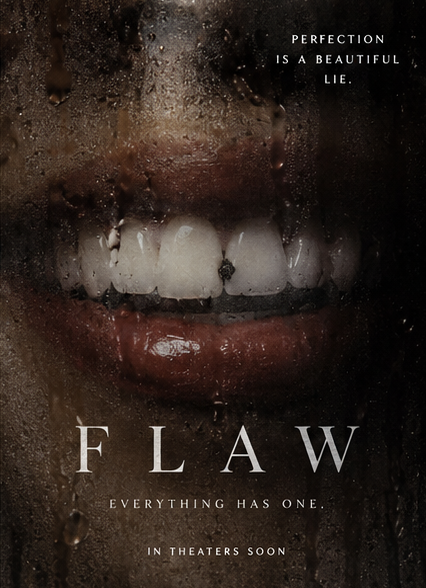
LOGLINE
A celebrated cosmetic dentist whose immaculate life conceals a violent obsession with correcting imperfection becomes quietly connected to a series of missing women. When his psychiatrist crosses paths with the detective investigating the disappearances, she begins to suspect that the charming patient she has been treating may be a killer, and her attempt to protect the woman he is seriously dating draws her into a trap designed for her.
PICTURE OVERVIEW
FLAW is an elevated psychological thriller about perfection, punishment, control, and the terrifying possibility that childhood lessons can survive long after childhood ends. Dr. Adrian Vale is a wealthy, charismatic cosmetic dentist whose life appears meticulously constructed: an elite practice, a luxury home, a disciplined body, successful friends, international travel, and an almost supernatural ability to remember the smallest details about the people around him.
Behind the immaculate image is a man who experiences imperfection as moral failure. A crooked frame, an uneven cuff, a stain, an asymmetrical smile, a fraction of body fat, or food caught between teeth can become unbearable. Adrian does not simply prefer order. He believes that if a flaw can be corrected, allowing it to remain is a choice.
That philosophy began decades earlier in a dental chair. As a child, Adrian was brought to a dentist with extensive cavities and several badly damaged baby teeth requiring extraction. The dentist recommended appropriate anesthesia and pain management. Adrian's father, Elias, refused to let his son escape the lesson. To Elias, the cavities were not merely decay. They were the consequence of Adrian failing to care for himself. The experience becomes one of the foundational traumas of Adrian's life, teaching him an equation he will carry into adulthood: imperfection leads to consequences, consequences lead to pain, and pain produces correction.
Years later, women begin disappearing across different cities. Detective Marcus Reed struggles to find a common thread until he discovers that one missing woman had been a patient at Adrian's dental practice and another may have visited the office. The connection is too weak for an accusation but strong enough for questions.
Adrian's psychiatrist, Dr. Maya Bennett, initially believes she is treating an unusually successful man suffering from obsessive behavior and a punishing need for control. When her path crosses Reed's investigation, details from Adrian's therapy suddenly take on another meaning. Meanwhile, Adrian enters a serious relationship with Eva, an intelligent and socially connected woman who appears to be moving toward a future with him.
When Adrian and Eva leave town for a romantic getaway, Maya becomes convinced Eva may be in danger. She begins looking more closely at Adrian's past and eventually attempts to intervene. But Adrian has already recognized the change in Maya. What she believes is an effort to rescue Eva becomes the very action Adrian anticipated. Eva appears to be the next victim. Maya is the threat Adrian actually intends to remove.
DR. ADRIAN VALE
Sophisticated, magnetic, physically disciplined, and extraordinarily attentive, Dr. Adrian Vale is one of the city's most sought-after cosmetic dentists. His profession allows him to turn his deepest psychological obsession into something society celebrates: correcting flaws.
His practice is built around symmetry, proportion, precision, and transformation. Patients thank him for changing their lives. Adrian loves the praise because it confirms the lesson buried inside him since childhood: correction creates worth.
His daily routines are exact. His clothes are arranged precisely. His home is immaculate. His oral-care routine is obsessive, involving repeated flossing, rinsing, whitening, and mirror checks. His body is constantly measured. A tiny change from 8.0 to 8.1 percent body fat can feel to him like evidence that he is becoming sloppy.
His internal cycle is consistent: imperfection, irritation, punishment, calm. He applies it to himself before he applies it to anyone else.
Adrian does not think of himself as a monster. He sees himself as someone willing to correct what other people tolerate. In his mind, everything can be fixed.
THE CHILDHOOD DENTAL CHAIR
Young Adrian is approximately eight or nine when Elias takes him to the dentist for what Adrian believes will be an ordinary examination. The dentist discovers extensive cavities and decay across several baby teeth. Multiple teeth need to be removed.
The dentist explains to Elias that Adrian should receive appropriate anesthesia and pain control for the extractions. Elias hears something different. He hears an opportunity to teach his son a lesson.
Adrian is frightened. Elias remains controlled. He reminds the boy that he had been told to brush his teeth. He had been told to take care of himself. In Elias's worldview, the condition of Adrian's mouth is not bad luck. It is evidence of a choice.
You knew you were supposed to brush your teeth. You made a choice. Choices have consequences.
Elias insists that Adrian experience the consequence. The scene is not photographed as graphic dental horror. The camera stays with the child's face, his hands gripping the chair, his father's presence, the clinical sounds, and the emotional betrayal of realizing that the person who should protect him has decided that pain is educational.
Afterward, Elias offers no conventional comfort. Instead, he gives Adrian the lesson that will quietly define the rest of his life.
Remember that pain. And you'll never let your mouth look like that again.
Adrian remembers.
The experience does not single-handedly create the adult killer. It becomes the emotional foundation upon which Adrian later constructs his own ideology. Dentistry becomes the place where helplessness can be reversed. As an adult, Adrian controls the chair. He controls the instruments. He decides what is imperfect. He decides what needs correction. He decides when the work is finished.
DR. ELIAS VALE
Dr. Elias Vale is demanding, intelligent, controlled, and emotionally severe. He believes discipline is love and that protecting children from consequences creates weakness. Adrian's childhood is filled with conditional approval: achievement earns warmth, while mistakes invite correction.
Elias's most damaging lesson is not simply that Adrian should strive for excellence. It is that pain can be morally deserved when someone fails to meet a standard.
Adult Adrian has expanded his father's philosophy into something Elias may never have imagined. The father's lesson was 'choices have consequences.' Adrian's version becomes 'flaws require correction.'
Elias continues to exist in the film through flashbacks, fragments of memory, and the internal language Adrian uses whenever control begins slipping.
DR. MAYA BENNETT
Dr. Maya Bennett is Adrian's psychiatrist: brilliant, perceptive, grounded, and difficult to manipulate. Initially she understands Adrian's compulsive behavior through the history he chooses to give her. He tells her his father was strict. He may even joke that his father made dental hygiene practically religious.
What Adrian does not initially tell Maya is what happened in the childhood dental chair. His sanitized version allows Maya to interpret his obsession as a product of high expectations rather than trauma fused with punishment.
After Detective Reed's investigation brushes against her professional world, Maya begins reconsidering old sessions. Eventually the truth about Adrian's childhood dental experience emerges. The revelation changes her understanding of him. Adrian does not merely associate imperfection with anxiety. Somewhere deep inside, he associates imperfection with deserved pain.
Maya recognizes that this does not explain away his adult choices. It explains the emotional language through which he rationalizes them.
EVA
Eva is intelligent, elegant, independent, socially connected, and emotionally grounded. Adrian's relationship with her becomes unusually serious. He introduces her to friends, allows her deeper into his routines, and begins discussing a future.
Eva initially interprets Adrian's precision as thoughtfulness. His memory feels romantic. His discipline feels attractive. Slowly she recognizes that his attention is also measurement.
Her visibility makes her different from the women connected to Reed's investigation. If Eva disappeared, people would immediately look for her. That makes her appear to be an unlikely target, while simultaneously making Maya fear Adrian's behavior may be escalating.
DETECTIVE MARCUS REED
Detective Marcus Reed has spent months examining a loose cluster of disappearances that never quite became one case. The women come from different backgrounds and places, leaving him without a clean common suspect.
His first meaningful break comes when he learns that one missing woman had been a patient at Adrian's practice. Another name appears connected to the office. Reed visits Adrian expecting defensiveness and instead encounters charm, cooperation, and an almost unnerving ability to remember details.
Reed leaves without probable cause and without deciding Adrian is guilty. But he keeps Adrian's name on the board.
When Reed later crosses paths with Maya, his questions force her to reinterpret behavior she had previously viewed strictly through a therapeutic lens. Reed follows evidence. Maya follows psychology. Their separate paths begin moving toward the same man.
ADRIAN'S FRIENDS & MEDICAL CIRCLE
Adrian moves through a circle of successful doctors, surgeons, dentists, and specialists. They train together, eat at expensive restaurants, compare cases, talk about women, money, techniques, and status. They tease Adrian about whether a dentist really counts as a doctor.
Adrian laughs with them. Privately, the joke reaches the childhood wound underneath his professional ambition. Being merely good is never enough. He must be undeniable.
THE HIDDEN PRACTICE
Beneath Adrian's immaculate public dental practice is an older clinical space hidden from the aspirational world above. Upstairs, patients arrive for transformations beneath bright lights and polished surfaces. Downstairs, Adrian's philosophy of correction takes on its private meaning.
The horror comes from contrast rather than graphic detail: trust above, secrecy below; beauty above, punishment below.
ACT I — THE PERFECT MAN
Perfection is control.
The film opens on an immaculate adult smile beneath clinical light. Adrian completes a cosmetic case with microscopic precision. The patient sees the result and becomes emotional. Adrian absorbs the gratitude with a restrained smile.
A clinical sound triggers the first fragment of memory: a child's hand gripping a dental chair.
We do not yet see the entire childhood scene.
The film moves through Adrian's adult life. His luxury condo is immaculate. His wardrobe is arranged precisely. His workout is punishing. His dental routine borders on ritual. At the gym his medical friends tease him about being a dentist among 'real doctors.' Adrian laughs. Later, alone, he notices a body-fat reading has shifted from 8.0 to 8.1 percent. His expression hardens.
Maya's sessions reveal a man who can describe his childhood with impressive psychological vocabulary. Adrian says his father was demanding and taught him accountability. Maya asks whether he ever felt afraid of disappointing him. Adrian smiles and reframes the question.
Eva enters his life. Their chemistry grows into something unusually serious. Adrian remembers every detail about her. His attention feels intoxicating.
During dinner, Eva casually points out something caught between Adrian's teeth. Adrian becomes still, thanks her, and excuses himself. In the restroom he repeatedly cleans and checks his mouth long after the problem is gone.
As he stares into the mirror, another childhood fragment appears: young Adrian in a dental chair, frightened, his father's hand resting firmly on the armrest beside him.
The following day Maya notices a bruise near Adrian's temple. He says he bumped his head while painting. Later the audience understands that he punished himself for failing to notice the flaw first.
Elsewhere, Detective Reed receives information connecting a missing woman to Adrian's dental practice. A second possible connection emerges. Reed walks into Adrian's office while patients move normally through the pristine space.
Adrian looks up and smiles.
ACT II — THE PATTERN
Reed questions Adrian informally. Adrian remembers the missing patient, expresses concern, and provides ordinary explanations. His cooperation is nearly perfect. Reed leaves with nothing actionable but an instinct that the answers sounded prepared even when they could not have been.
The investigation eventually brushes against Maya. Reed asks whether she knows Adrian and explains only what he appropriately can: Adrian's name has surfaced while he is looking into missing women. Maya protects her professional boundaries, but the conversation changes the way she hears her patient.
In their next session Adrian talks about carelessness. He says people usually know what they are supposed to do. They simply choose not to do it. Maya asks where he learned that.
For the first time, Adrian tells her about the dentist.
The childhood memory finally plays in full. Eight-year-old Adrian sits in the chair after the dentist explains the extent of the decay and the need for several extractions. The dentist recommends appropriate anesthesia and pain management. Elias refuses the lesson being softened. Young Adrian looks toward his father for rescue and finds judgment instead.
You made a choice. Choices have consequences.
The film remains with Adrian's fear rather than the procedure itself. When it is over, Elias tells him to remember the pain.
Back in the present, Maya is visibly affected but controlled. Adrian describes the story almost proudly. He credits his father with teaching him discipline. Maya hears something Adrian does not: he has converted trauma into gratitude because accepting the cruelty of the event would destabilize the philosophy upon which his entire life is built.
Maya begins recognizing the deeper equation: imperfection, consequence, pain, correction.
Meanwhile, Adrian and Eva become increasingly serious and plan a romantic getaway outside the city. Maya learns enough about the trip to become concerned. Public fragments from Adrian's past travel begin overlapping with Reed's investigation. A photograph that appears to show Adrian alone contains a subtle suggestion that someone else was present.
Adrian senses Maya's changing attention. He begins studying her instead.
THE GETAWAY
Adrian and Eva leave together for an intimate retreat. The sequence is romantic enough to make the audience question its own suspicion. Adrian appears relaxed, funny, affectionate, and perhaps genuinely in love.
Back home, Maya speaks with Reed again. Neither possesses enough information alone. Reed has circumstantial connections. Maya has psychological alarm bells she cannot simply turn into evidence.
Maya finds one additional non-confidential detail that places something Adrian has said against the timeline of a disappearance. It does not prove murder. It makes coincidence harder to accept.
She becomes convinced Eva may be in danger.
Against Reed's warning not to investigate on her own, Maya reaches out to Eva. Eva is initially defensive. From her perspective, Adrian's psychiatrist suddenly warning her about him sounds inappropriate and possibly obsessive.
Adrian has already anticipated that reaction.
ACT III — THE TRAP
Eva begins quietly watching Adrian after Maya's warning. Adrian notices almost immediately. Instead of becoming threatening, he becomes more vulnerable and loving. He gives Eva exactly the version of himself that makes Maya's warning appear irrational.
Eva eventually agrees to meet Maya privately. Maya believes she is finally getting Eva away from Adrian long enough to explain the pattern.
But Adrian knows about the meeting.
The attempted rescue becomes the trap. Adrian has allowed Maya to believe Eva is in immediate danger because Maya's protective instinct makes her predictable. Her effort to save Eva isolates her and gives Adrian an opportunity to frame Maya as a psychiatrist whose fascination with a patient has crossed professional boundaries.
At the same time, Reed discovers that the dental-practice connection extends further than he first understood. He tries to reach Maya.
Maya lays out the pattern for Eva carefully. Not certainty. Not accusation presented as fact. A pattern. Eva begins recognizing details she has independently witnessed: the rituals, the judgment, the travel inconsistencies, the way Adrian changes when something escapes his control.
Then Maya understands the reversal.
Eva is the bait. Maya is the target.
THE ENDGAME
Maya recognizes that Adrian's childhood wound contains the weakness inside his adult system. Adrian can survive suspicion. What he cannot tolerate is the possibility that he missed something.
She deliberately introduces uncertainty. She lets Adrian believe that evidence may already exist outside his control without telling him what it is. She implies Reed knows something Adrian cannot identify. She leaves him unable to determine which flaw in his history has finally exposed him.
The uncertainty attacks him more effectively than accusation. His routines intensify. He rechecks his teeth. Corrects objects already aligned. Repeats details. Contradicts himself. The polished man begins disappearing beneath the frightened child who once sat in the dental chair waiting for punishment.
THE CONFRONTATION
Maya finally confronts the belief Adrian has protected his entire life. His father did not teach him perfection. He taught him fear.
Perfection does not make you superior. It makes you afraid.
For Adrian, the statement is unbearable because it turns his greatest strength into his deepest flaw.
He attempts to correct Maya. Correct her interpretation. Correct the evidence. Correct the story. In doing so, he creates the mistake that Reed has been waiting for.
THE FINAL FLAW
Adrian's downfall comes from the same psychological machinery that made him formidable. A less obsessive person might leave an unanswered question alone. Adrian cannot.
The film returns one final time to the childhood dental chair, but the memory changes. Adult Adrian has always remembered his father's lesson as strength. Now the audience sees what was actually there: a terrified child learning that the person he trusted would allow him to suffer in the name of correction.
The final image echoes the opening: a smile under clinical light.
Perfect teeth.
And somewhere within the perfection, evidence of everything Adrian could never fix.
THEMES
FLAW explores generational trauma without using trauma to excuse adult violence. Adrian's childhood helps explain the language through which he understands punishment, but his adult choices remain his own.
The film examines the difference between discipline and domination, care and control, attention and surveillance, and correction and cruelty.
Its central psychological equation is simple: Adrian was taught that pain follows imperfection. He grows into a man who believes he has the authority to decide what is imperfect.
VISUAL LANGUAGE
Adrian's adult world should be expensive, geometric, clean, and seductive. The childhood dental office should initially share some of the same visual vocabulary, allowing sterile whites, metal, mirrors, and clinical lighting to connect past and present without announcing the connection.
Dental sounds and images can function as memory triggers throughout the film: the click of an instrument, a bright examination light, a gloved hand, a child's grip on an armrest. The full childhood memory is withheld until Maya finally reaches the origin of Adrian's philosophy.
The hidden practice should remain clinical rather than gothic. The horror is that Adrian has transformed the place associated with his childhood helplessness into the environment in which he now possesses total control.
CASTING VISION
Tyler Lepley as Dr. Adrian Vale. The role requires sophistication, charm, physical discipline, romantic credibility, and the ability to let the frightened child beneath Adrian's immaculate exterior emerge only in microscopic flashes.
Taraji P. Henson as Dr. Maya Bennett. Maya requires intelligence, emotional authority, restraint, and the ability to understand Adrian without reducing him to a diagnosis.
Eva Marcille as Eva. Eva must feel socially grounded and substantial enough for Adrian's relationship with her to plausibly become his most serious adult romance.
Detective Marcus Reed is envisioned as a major supporting role for an actor with quiet authority and patience. Reed does not decide Adrian is guilty and then seek confirmation. He follows the evidence until the pattern becomes impossible to ignore.
Young Adrian should be cast with a child actor capable of carrying the dental-chair sequence primarily through expression. The scene works because the audience watches trust become fear.
FINAL NOTE
The childhood dental sequence gives FLAW its emotional spine. Adrian's adult obsession with teeth is no longer simply an eccentric character detail or occupational irony. Dentistry is the site of his earliest remembered helplessness, the profession through which he later reclaims control, and the language through which he rationalizes correction.
The detective follows what Adrian did. Maya discovers why Adrian thinks the way he does. Eva reveals what happens when his controlled world encounters genuine intimacy.
Together, those three perspectives close around a man who spent his entire life eliminating flaws without realizing that the system he built to protect himself had become the greatest flaw of all.